
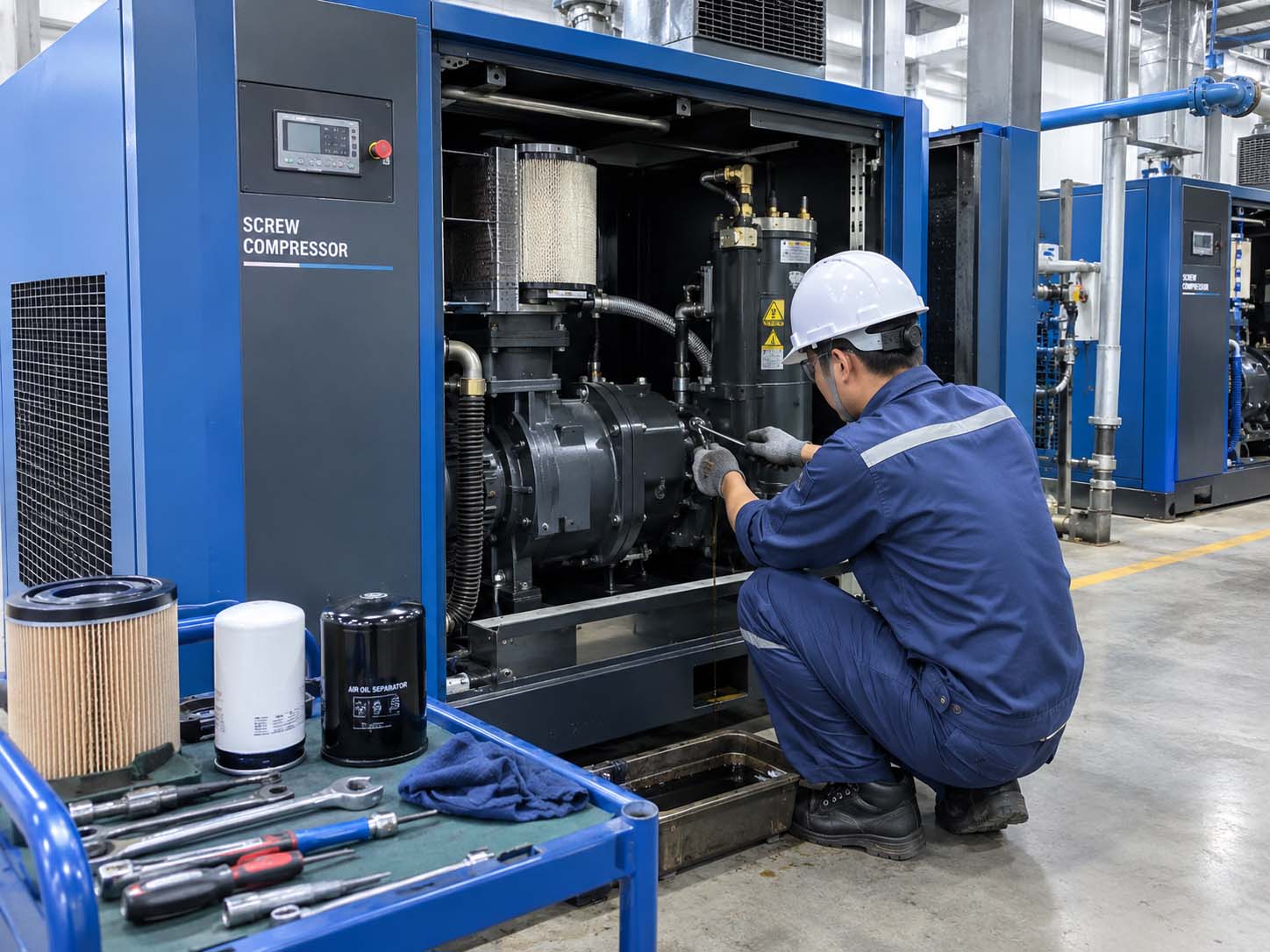
Why is running 24/7 without maintenance a double-edged sword?
Rotary screw compressors are built for continuous duty, so many plants run them until an alarm appears. The short-term gain is no downtime for service; the price is the risk of stopping the whole line when compressed air is lost.
A year has 8,760 hours. A compressor running 24/7 reaches its 2,000-hour service after about 12 weeks and its 8,000-hour oil change after about 11 months. Missing these milestones leads to a familiar chain of failures:
- Degraded oil loses its lubricating and cooling ability, and discharge temperature climbs to the shutdown limit (about 109°C on many Ingersoll Rand models).
- A clogged air/oil separator raises differential pressure, wastes power and lets oil carry over into the production line.
- Airend bearings wear quickly. An airend overhaul usually costs dozens of times more than a routine service.
Maintenance schedule by running hours
The manufacturer’s basic rule: service at whichever comes first, running hours or calendar time. Ingersoll Rand also sets a priority order: follow controller alerts first, then hour milestones, then the annual interval.
| Running hours | Main tasks | Manufacturer notes |
|---|---|---|
| First 150 – 1,000 h | Replace first oil filter; replace break-in oil (on machines using break-in oil) | Ingersoll Rand: replace coolant filter at the first 150 hours |
| 2,000 – 3,000 h | Replace oil filter; inspect electrical system; clean cooler; take oil sample for analysis | Ingersoll Rand: coolant filter every 2,000 hours or annually |
| 4,000 – 6,000 h (or 1 year) | Replace air filter; inspect inlet valve; check belt tension | Some R-Series models require air filter and separator changes earlier, at 2,000 hours |
| 8,000 – 12,000 h | Replace synthetic oil; inspect or replace separator; service thermostatic valve; fit inlet valve and minimum pressure valve kits | Ultra Coolant: 8,000 hours or 2 years |
First 500 – 1,000 hours: replace break-in oil, check the oil filter
The break-in period produces metal particles and assembly debris, so the first oil filter is always changed earlier than later ones. For Ingersoll Rand machines factory-filled with Ultra Coolant, the manufacturer requires a coolant filter change at 150 hours. For machines that use mineral break-in oil, common on some brands such as Deman, the first oil and filter change usually falls between 500 and 1,000 hours.
This is also the time to re-tighten electrical terminals and pipe joints, because initial vibration tends to loosen them.
2,000 – 3,000 hours: replace oil filter, check electrics, clean the cooler
At this milestone, replace the oil filter, inspect the electrical system and clean the cooler. The Ingersoll Rand manual also recommends oil sampling and vibration analysis at 2,000 hours to catch bearing damage early.
- Electrical system: re-tighten terminals, inspect starter contactors, measure three-phase current to detect imbalance.
- Cooler: blow dust out against the airflow and use a dedicated cleaner where oil has built up. A dirty cooler raises airend temperature and causes trips in hot weather.
4,000 – 6,000 hours (or 1 year): replace air filter, check inlet valve and belts
At this milestone, replace the air filter and inspect the inlet valve and belt tension. In dusty environments such as cement, wood or textiles, change the air filter sooner, as signaled by the controller’s differential pressure alarm.
- Inlet valve: check sealing, diaphragm and springs; a sluggish valve slows loading and wastes energy.
- Drive belts (belt-driven units): check tension and cracks; a slack belt slips, overheats and reduces airflow.
8,000 – 12,000 hours: replace synthetic oil, separator and thermostatic valve
This is the biggest service of the year. Ingersoll Rand Ultra Coolant is changed every 8,000 hours or 2 years, whichever comes first; Ultra EL extends that to 16,000 hours or 3 years.
- Replace the specified synthetic oil: never mix lubricant types; fully drain old oil from the separator tank and lines.
- Air/oil separator: replace by differential pressure or at the model’s hour interval.
- Thermostatic valve: inspect and fit a new kit if it sticks; a failed valve stops oil from passing through the cooler and temperature rises fast.
- Inlet valve and minimum pressure valve kits: replace with the manufacturer’s service kits.
Note: actual intervals depend on the model, lubricant and installation environment. Always follow the service manual for your specific model first.
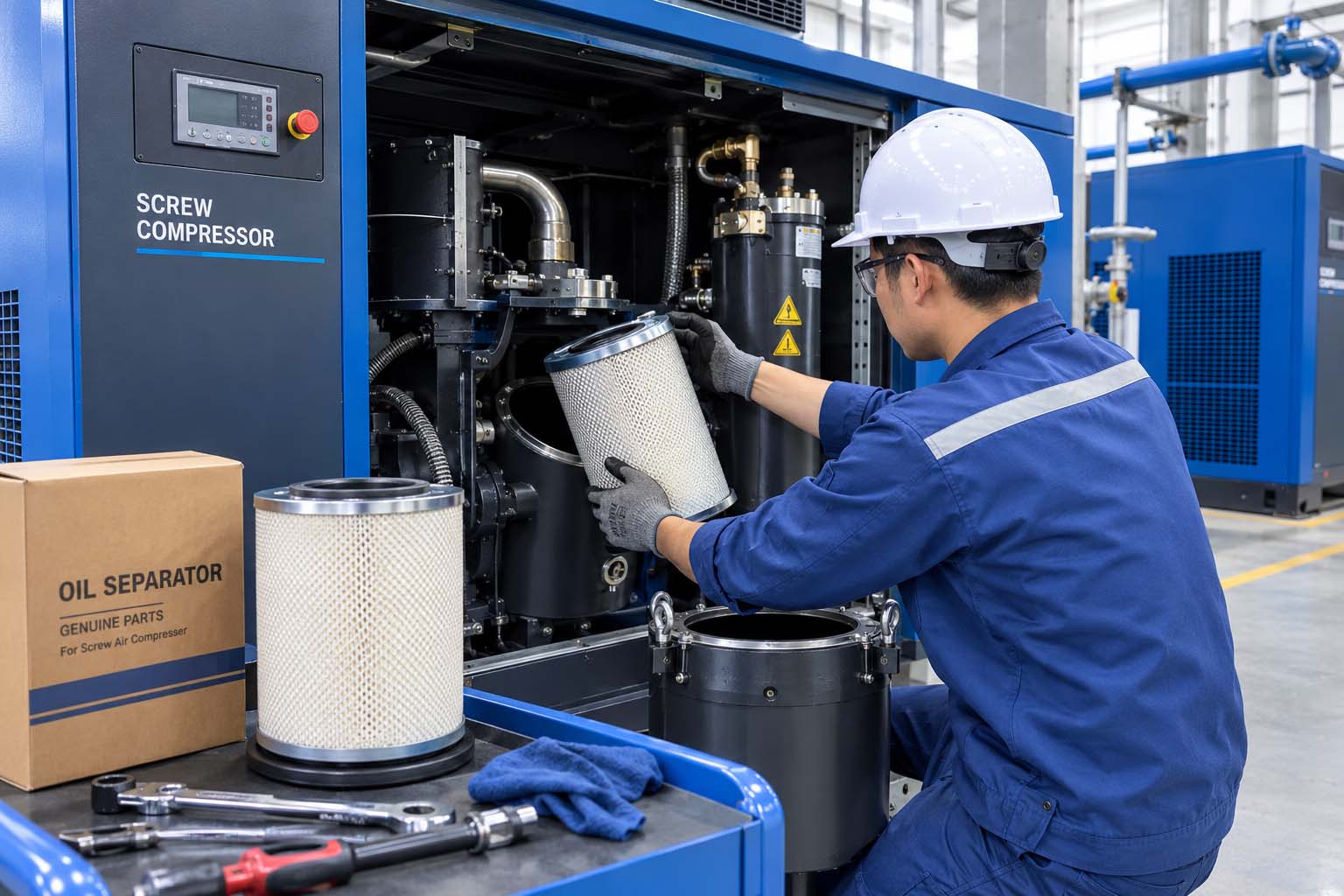
Weekly and monthly inspection checklist
Beyond the major milestones, operators should routinely check four groups of parameters: temperature, pressure, noise and vibration. Log the readings and compare trends, because gradual change is the earliest sign of failure.
| Frequency | Item | Warning sign |
|---|---|---|
| Daily | Oil level, oil/air leaks, controller alerts | Oil below the mark, oil under the machine |
| Weekly | Airend discharge temperature | 5–10°C above normal |
| Weekly | Separator and air filter differential pressure | Approaching the alarm limit |
| Weekly | Working pressure, loaded/unloaded time | Pressure swings, excessive unloaded running |
| Weekly | Condensate drains on receiver and dryer | Automatic drain not operating |
| Monthly | Abnormal noise | Whining or knocking at airend or motor |
| Monthly | Motor and airend vibration | Higher than the previous reading |
| Monthly | Dust on cooler, compressor room temperature | Dusty cooler, room above 40°C |
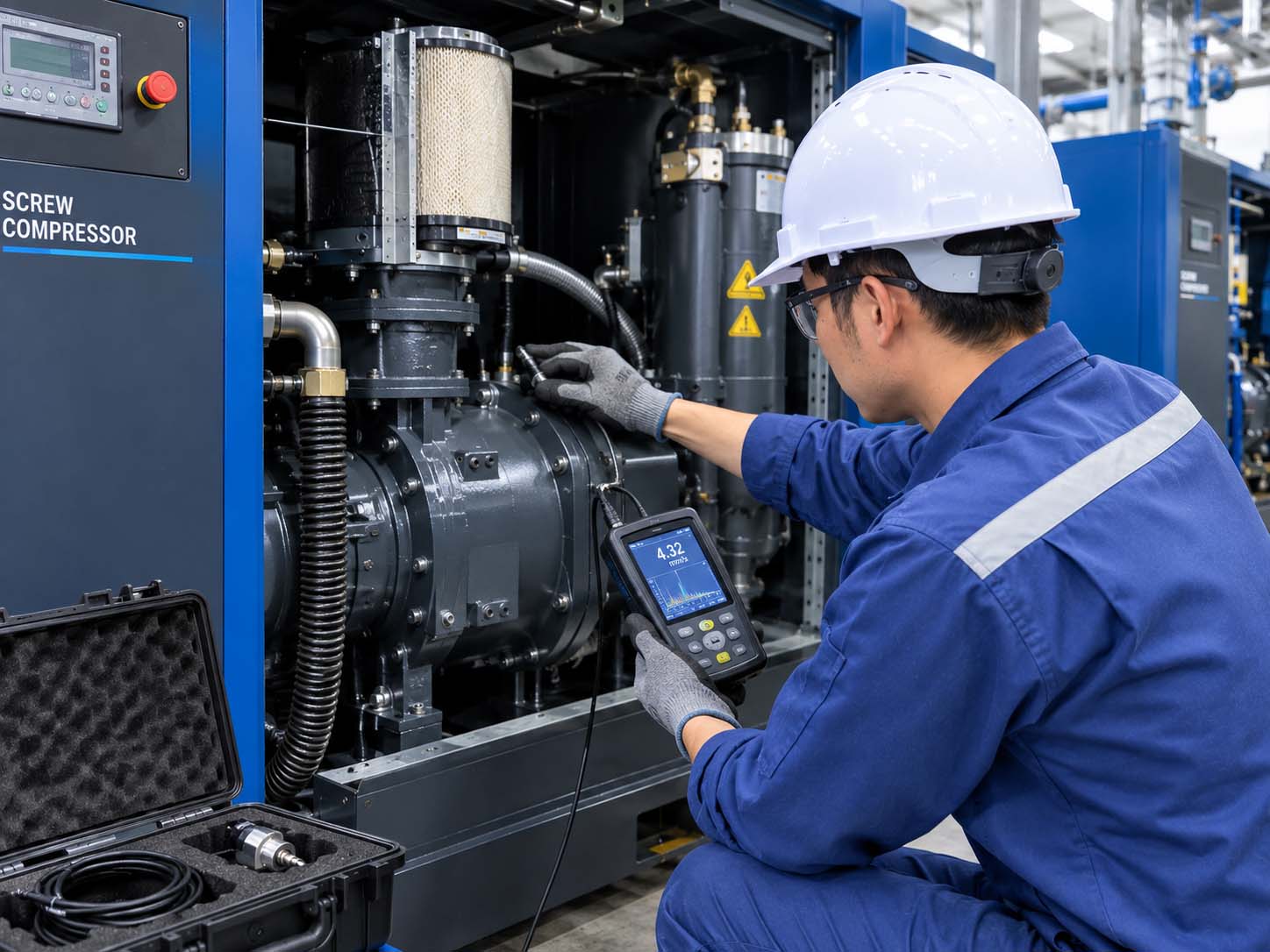
Full-service maintenance from Tay Ho Star
Tay Ho Star is an Ingersoll Rand air compressor distributor offering full-service maintenance for rotary screw compressors on site:
- Genuine parts: air filters, oil filters, separators, Ultra Coolant and valve kits from Ingersoll Rand and Deman, with traceable origin.
- Skilled technicians on site: Ingersoll Rand maintenance procedures carried out exactly per the manual, from filter changes to airend overhauls.
- Automatic reminders: running hours tracked for each machine, with service booked ahead of every milestone.
- Report after every visit: temperature, pressure and vibration readings recorded so your plant can follow trends.
Frequently asked questions
How often should rotary screw compressor oil be changed? With Ingersoll Rand Ultra Coolant synthetic oil, every 8,000 hours or 2 years, whichever comes first. Mineral oils usually have shorter intervals.
How often should the air/oil separator be replaced? Depending on the model, typically every 2,000 to 8,000 hours, or sooner if differential pressure exceeds the alarm limit.
Do weekly checks require stopping the compressor? Most items, such as temperature, pressure and filter differential pressure, can be read on the controller while the machine runs.
Sign up for a preventive maintenance plan for your plant
Don’t wait for an alarm in the middle of a production shift. Sign up for a professional preventive maintenance plan from Tay Ho Star to keep your compressors running reliably, to factory standard and on schedule.
👉 Book your free audit today:
-
Hotline: 096 828 1912
-
Email: quanghuy@tayhostar.vn
-
Office Address: 91 Trung Kinh, Trung Hoa Ward, Cau Giay District, Hanoi, Vietnam
-
Website: https://tayhostar.vn/