
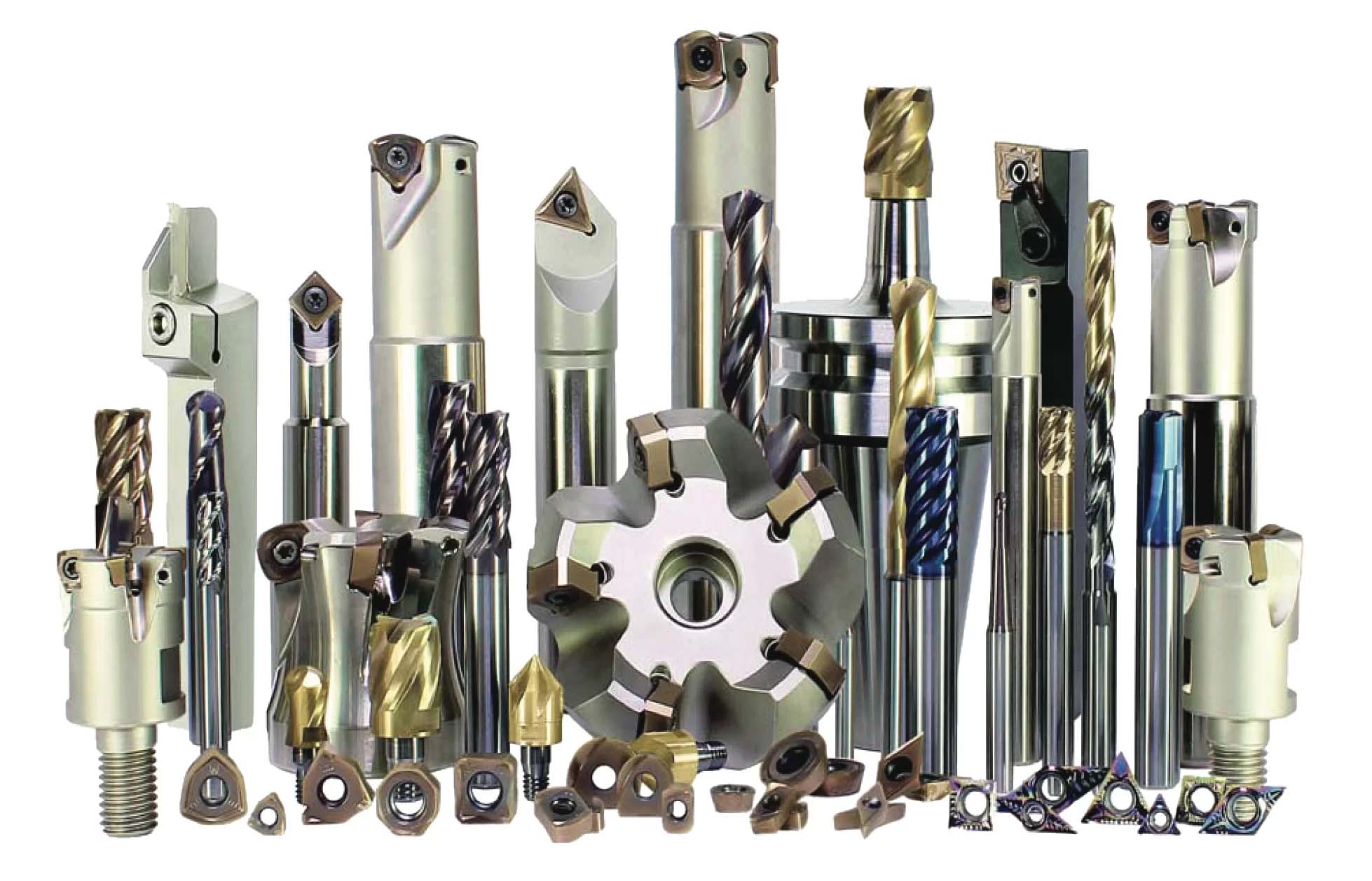
Why are stainless steel, hardened steel and titanium hard to machine?
All three cause rapid tool wear, edge chipping and high cutting temperatures, but each for a different reason. Understanding the cause is the first step to choosing the right tool.
| Material | What makes it difficult | Typical tool failure |
|---|---|---|
| Austenitic stainless 304, 316 (ISO M) | Work hardens, poor thermal conductivity, gummy chips | Depth-of-cut notching, built-up edge, chipping |
| Hardened alloy and plated steel (ISO H/P) | High hardness of 40–55 HRC, high cutting forces | Fast flank wear, corner breakage |
| Titanium Ti-6Al-4V (ISO S) | Very poor thermal conductivity concentrates heat at the edge; reacts chemically with tool material | Crater wear, plastic deformation of the edge |
With general-purpose tools, the result is short tool life, frequent stops to change tools and lower cutting speeds just to make tools last. The whole line’s output is pulled down to the level of its weakest tool.
Kennametal’s technology answer
Kennametal tackles this by combining three elements: heat-resistant coatings, carbide substrates engineered for each application and optimized edge geometry. The company uses both PVD coatings (sharp edges and low built-up edge, suited to stainless and titanium) and CVD coatings (thick layers with Al₂O₃ against crater wear, suited to high-speed steel cutting).
KC725M milling inserts: the versatile workhorse
KC725M is a multi-layer PVD TiAlN-coated carbide grade on a tough substrate with 11.5% cobalt. It covers ISO P, M and K 15–35, and Kennametal recommends it for milling steel, stainless steel and high-temperature alloys.
- Good thermal shock resistance for both wet and dry machining.
- Reference speed range: about 90–200 m/min in steel and 60–150 m/min in stainless steel.
- Well suited to roughing and semi-finishing, especially on less rigid machines or fixtures.
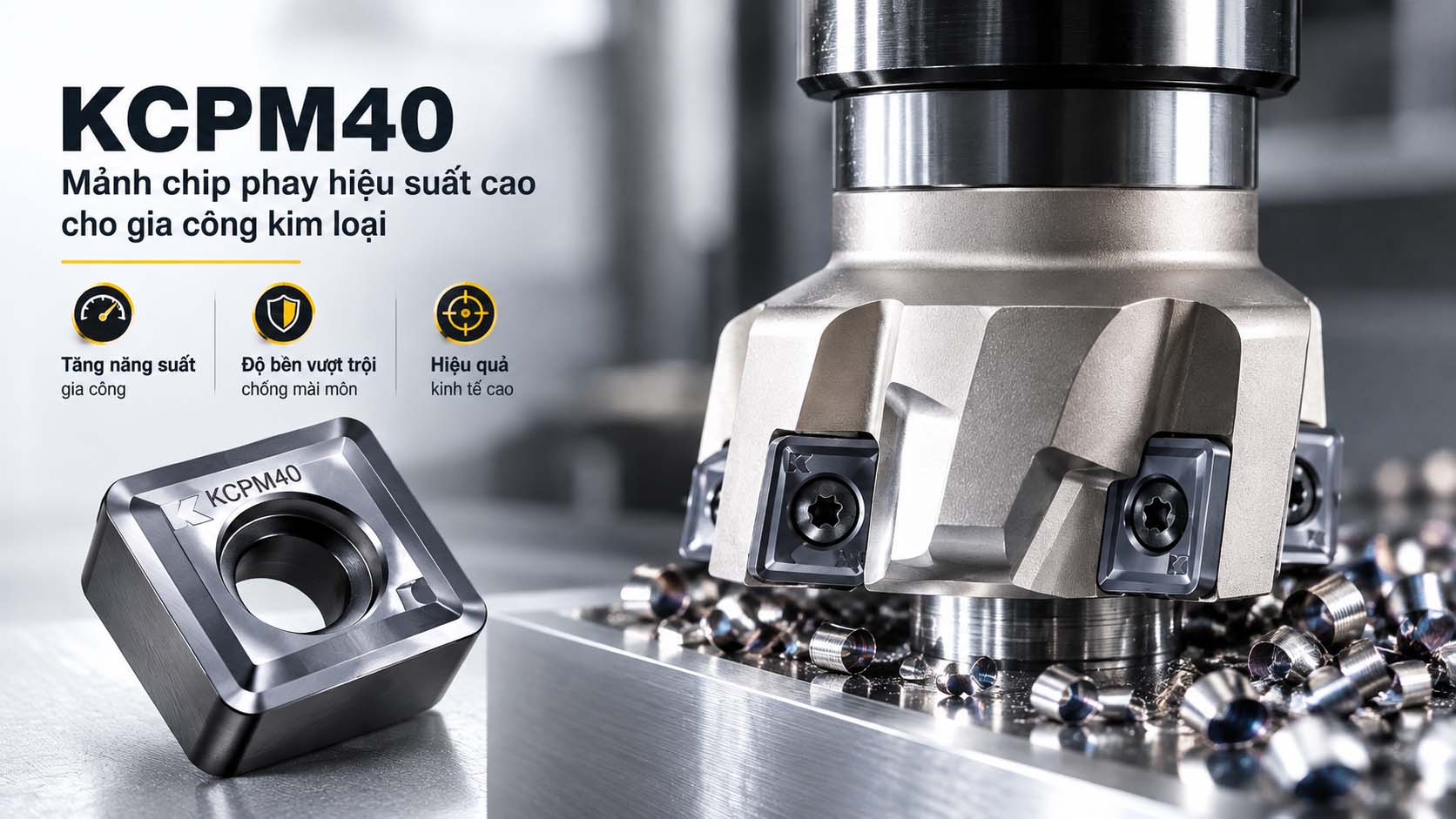
KCPM40™ milling inserts: first choice for steel and stainless
KCPM40 belongs to the Beyond™ family, with a PVD TiAlN/AlCrN coating on a tough substrate that retains strength at high temperature. Kennametal positions it as the first choice for milling steel and stainless steel, mainly in general to heavy machining.
- The added AlCrN layer resists oxidation and wear in the hot cutting zone of 316 stainless.
- Good thermal shock resistance for interrupted cuts and heavy roughing.
- Available across many face and shoulder milling platforms such as Mill 1™ and Mega.
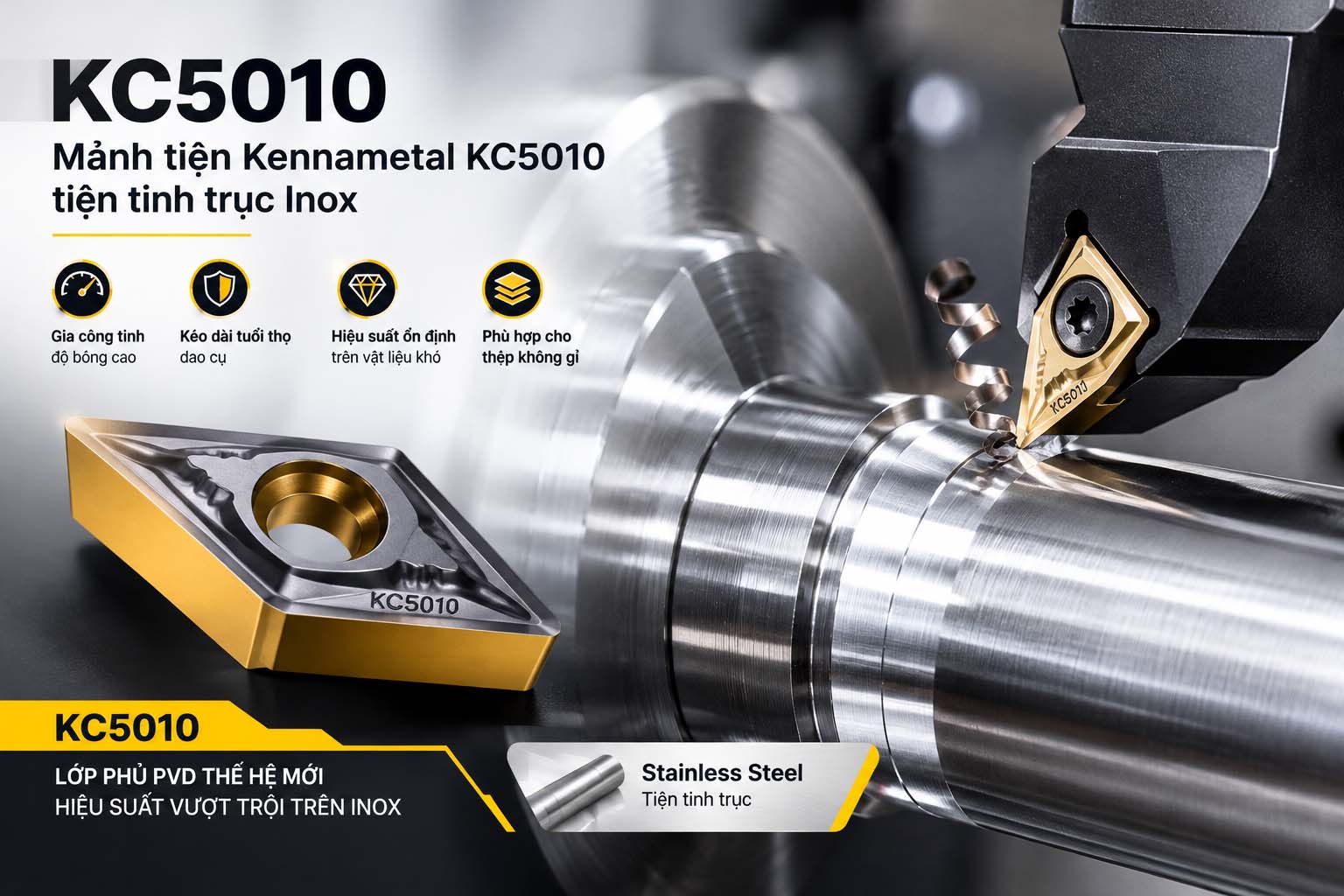
KC5010 turning inserts: high speed for finishing
KC5010 is a Kennametal turning grade with a PVD AlTiN coating on an unalloyed, deformation-resistant carbide substrate. It covers ISO P, M, K, N and S 10–20 and performs well on hardened materials.
- According to Kennametal, its newer AlTiN coating allows cutting speeds to rise by 50–100% compared with the previous coating.
- Ideal for finishing and semi-finishing stainless steel, alloy steel, superalloys and titanium under stable conditions.
HARVI™ I TE solid carbide end mills
HARVI I TE is a four-flute solid carbide end mill for steel, stainless steel, cast iron, high-temperature alloys and hardened materials up to about 48 HRC (up to 52 HRC with grade KCSM15). Its edge comes from geometry:
- Asymmetric flute spacing and variable helix: suppresses vibration for smooth cutting at large depths.
- Twisted end face: strengthens the corner and enables steep ramping.
- Chip gashes in the flutes: reduce cutting forces and support chip evacuation.
- One tool handles slotting, shoulder milling, ramping, helical interpolation and dynamic milling.
For titanium, Kennametal also offers dedicated grades such as KCSM40 for indexable milling, designed to raise cutting speeds in Ti-6Al-4V.
Choosing a Kennametal grade by material
| Material | Operation | Suggested grade / tool |
|---|---|---|
| Stainless 304, 316 | Face and shoulder milling | KCPM40, KC725M |
| Stainless 304, 316 | Finish turning | KC5010 |
| Alloy and plated steel | Heavy roughing | KCPM40 |
| Hardened steel up to ~48–52 HRC | Slotting, pocketing | HARVI I TE (KCSM15) |
| Titanium Ti-6Al-4V | Milling | HARVI I TE; KC725M; KCSM40 |
| Titanium, superalloys | Finish turning | KC5010 |
This table is a starting point; actual cutting data must be calculated for your machine, fixture and part.
Chip evacuation, heat resistance and durability: Kennametal vs. general-purpose tools
The biggest difference between Kennametal and general-purpose tools is not hardness but how stable the cutting edge stays as temperature rises.
| Criterion | General-purpose tools | Kennametal tools |
|---|---|---|
| Coating | Single-layer TiN/TiCN, low heat resistance | Multi-layer TiAlN, AlTiN, AlCrN forming a protective aluminum oxide layer at high temperature |
| Substrate | One substrate for many applications | Purpose-built: tough (KC725M), deformation-resistant (KC5010) |
| Chip evacuation | Even flutes, prone to clogging with gummy stainless chips | Chip gashes, asymmetric flutes (HARVI I TE) |
| Vibration | Chatter at large depths of cut | Variable helix suppresses chatter |
| Batch consistency | Variable | Consistent, easy to standardize parameters |
In practice, batch-to-batch consistency is what process engineers value most. Consistent tools let you set a fixed tool life in the CNC program and change tools on schedule instead of waiting for breakage.
Economic benefits: less downtime, higher cutting speed
Switching to the right Kennametal tools can cut tool-change downtime by around 30% and up to double the cutting speed (Vc) in many operations. A Vc gain of up to 100% matches Kennametal’s published figure for the KC5010 AlTiN coating.
A Kennametal insert usually costs more than a general-purpose one, but tooling is only a small share of part cost. Most of it is machine time and labor. The right metric is therefore cost per part, not price per insert:
- Longer tool life: fewer stops for tool changes, fewer re-measurements, less scrap from worn tools.
- Higher Vc: shorter cycle times, more parts per machine per shift.
- Stable parameters: easier lights-out or lightly staffed night shifts.
Frequently asked questions
What is the difference between KC725M and KCPM40? Both are PVD grades for milling steel and stainless. KC725M has a TiAlN coating and is versatile with good thermal shock resistance; KCPM40 has a TiAlN/AlCrN coating and is Kennametal’s first choice for milling steel and stainless in general to heavy machining.
Which Kennametal tools are used for titanium? HARVI I TE for solid end milling, KC5010 for finish turning, and dedicated KCSM grades for indexable titanium milling.
How hard a steel can HARVI I TE machine? About 48 HRC according to Kennametal’s selection guide; grade KCSM15 is rated up to 52 HRC.
Genuine Kennametal tools from Tay Ho Star
Tay Ho Star distributes Kennametal cutting tools in Vietnam, supplying genuine Kennametal milling cutters, turning and milling inserts and HARVI™ solid end mills. Tay Ho Star application engineers help select grades, calculate cutting data and run trials directly on your machines.
👉 Contact Tay Ho Star for advice Kennametal tools:
-
Hotline: 096 828 1912
-
Email: quanghuy@tayhostar.vn
-
Office Address: 91 Trung Kính, P. Trung Hòa, Q. Cầu Giấy, Hà Nội
-
Website: https://tayhostar.vn/