
Why is electricity the biggest cost of an air compressor?
Over 10 years of operation, the purchase price is only about 10–15% of total cost and maintenance roughly 10%; the rest is energy. Compressed air is the most expensive utility in a plant: running a 1 HP air motor takes 7–8 HP of electrical input at the compressor, with most of the difference lost as heat.
A concrete example: a 75 kW compressor running 8,000 hours a year at 80% average load, with electricity at VND 2,000/kWh, costs about VND 960 million (≈ USD 37,000) in power every year. Optimizing the compressed air system by just 20% keeps nearly VND 200 million a year in the plant’s budget, for a single machine.
Solution 1: Choose the right size and technology (Variable Speed Drive)
A variable speed drive (VSD) compressor can use up to 35% less energy than a fixed speed unit when air demand fluctuates. That is Ingersoll Rand’s published figure for its VSD R-Series rotary screw compressors versus fixed speed models.
A fixed speed compressor has only two states: loaded and unloaded. When unloaded it produces no air but still draws about 20–30% of its rated power. A VSD compressor varies motor speed to match real-time air demand, holding pressure in a tight band and eliminating almost all unloaded running.
| Criterion | Fixed speed compressor | VSD rotary screw compressor |
|---|---|---|
| Control method | Load / unload | Continuous motor speed control |
| Power when idle | 20–30% of rated power | Near zero (slows down or stops) |
| Pressure band | Wide (typically 1 bar) | Narrow (about ±0.1 bar) |
| Starting current | High, causes grid voltage dips | Soft start, low current |
| Best fit | Stable base load above 80% | Demand that varies by shift or season |
Energy-efficient rotary screw compressors such as Ingersoll Rand VSD or Deman VSD models deliver the most when demand changes through the day. A VSD is not always better, though: at a constant 100% speed, inverter losses make it slightly less efficient than an identical fixed speed machine.
On sizing, the most common mistake is buying a compressor that is too big “to be safe”. An oversized unit spends hours unloaded and cycles constantly. A healthy average load is 70–85%; below 40% signals the need for a VSD or a sizing review.
Solution 2: Fix compressed air leaks
A poorly maintained compressed air system typically loses 20–30% of its output through leaks, according to the U.S. Department of Energy (DOE). A well-managed system keeps leakage below 10%.
To put that in perspective, a single 3 mm (1/8 inch) hole at about 7 bar wastes around 15 cfm (0.43 m³/min), equal to 2.7 kW of electrical power. In a 24/7 plant, that one leak costs roughly VND 47 million (≈ USD 1,800) a year, and most plants have dozens of leaks at once.
Leaks also cause pressure drop at the far end of the network. The usual reaction is to raise the compressor set point, but every extra 1 bar adds about 7% to energy use and makes every leak blow harder.
A routine leak inspection has four steps:
- Measure baseline leakage: run the compressor with all air-using equipment stopped (breaks, weekends). Record loaded time (T) and unloaded time (t); leakage ≈ T / (T + t) × 100%.
- Locate leaks with an ultrasonic detector: it finds small leaks that are inaudible over factory noise.
- Tag and rank: fix the largest leaks first, usually at quick couplings, hoses, condensate drains and filter-regulator-lubricator (FRL) units.
- Re-check every quarter: compare against the baseline to prove the savings in numbers.
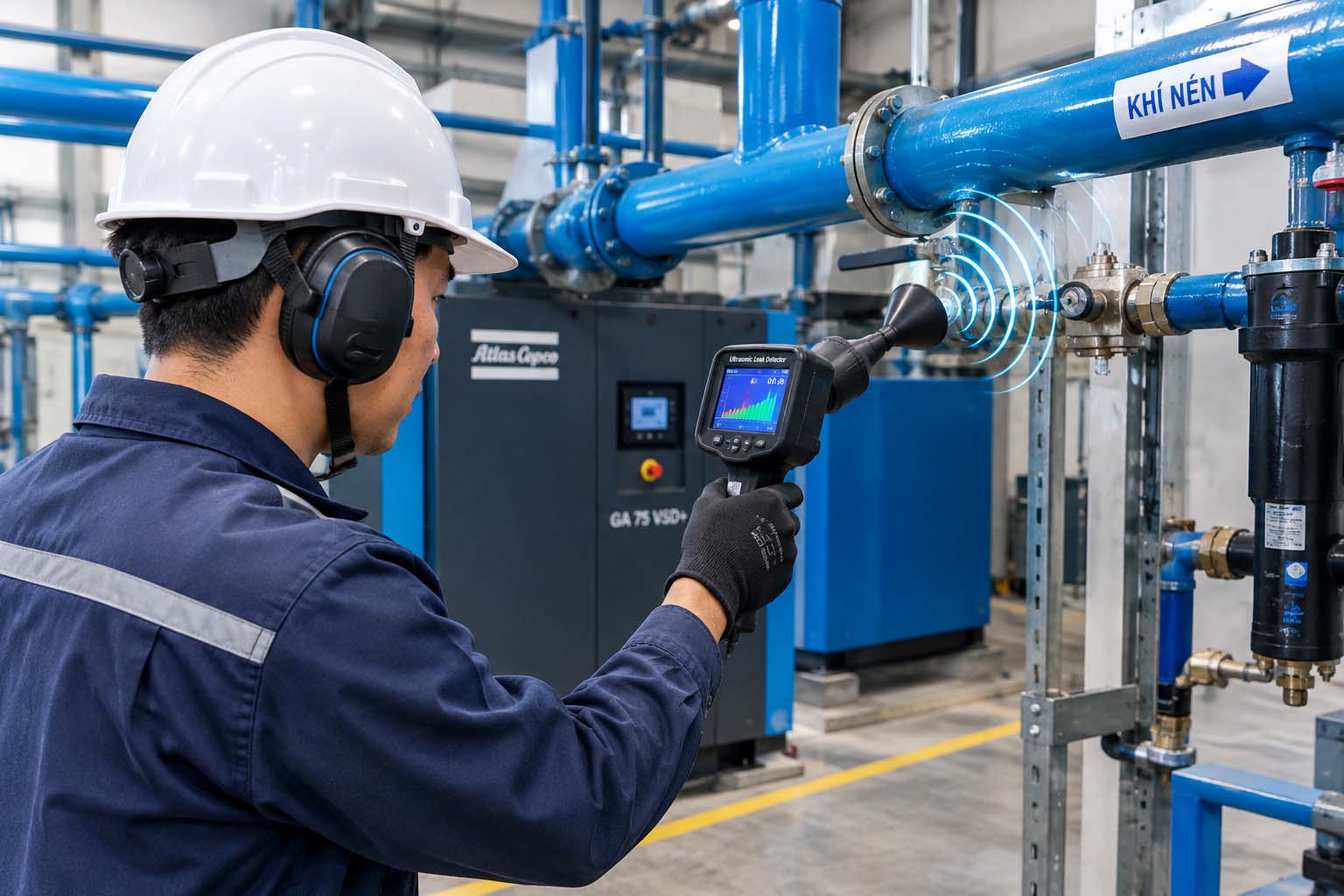
Solution 3: Optimize compressor room temperature and air piping
The cooler the intake air, the less power the compressor needs: every 3–4°C reduction in intake temperature saves about 1% of energy. Cool air is denser, so each rotation of the screw element compresses more air.
Compressor room ventilation
- Draw fresh air from the cool, shaded side of the building and avoid recirculating hot air from the cooler.
- Duct hot exhaust air from the cooler outdoors instead of releasing it inside the room.
- Keep the room below the manufacturer’s limit (typically 40–46°C). In a hot, humid climate like Vietnam’s, this is the most commonly overlooked factor.
- Consider heat recovery: most of the input energy becomes heat, which can preheat boiler feed water or process water.
Correct pipe sizing to avoid pressure drop
- Design the main distribution so pressure loss from the compressor room to the farthest point of use stays below 0.1 bar.
- Keep air velocity in the main header around 6 m/s; undersized pipe creates friction and pressure drop.
- Use a ring main so air reaches each point from two directions and pressure stays stable.
- Minimize sharp elbows and reducers; consider aluminum piping to replace internally corroded steel.
Solution 4: Replace filters and service on schedule
Dirty filters make a compressor use more power in ways operators cannot see. A clogged intake filter lowers inlet pressure, so the machine runs longer to deliver the same air. A fouled oil separator or line filter raises differential pressure, forcing the compressor to work at a higher discharge pressure.
An extra 0.7 bar of pressure drop across filters can raise energy consumption by about 5%. Replacing filters on time costs far less than the wasted electricity.
| Item | Typical interval | Sign it needs attention |
|---|---|---|
| Intake air filter | Check weekly; replace every 2,000–4,000 h | Differential pressure alarm, heavy dust |
| Oil filter | 2,000–4,000 h | Rising airend temperature |
| Oil separator | 4,000–8,000 h | High differential pressure, oil carryover |
| Line filters | By differential pressure | Above manufacturer’s limit |
| Cooler | Clean every 3–6 months | High discharge air temperature |
Actual intervals depend on dust, temperature and each manufacturer’s recommendations. Use genuine parts to keep the design pressure drop and the warranty.
Solution 5: Plan multi-compressor operation (cascade control)
In plants with three or more compressors, a central controller can save a further 10–20% of energy compared with letting each machine run on its own pressure switch.
Traditional cascade control staggers each machine’s pressure settings, for example compressor 1 at 7.0–7.5 bar and compressor 2 at 7.3–7.8 bar. The result is a wide system pressure band, several machines running part-loaded, and an average pressure well above real demand.
Principles of effective coordination:
- Fixed speed units carry the base load, always fully loaded at peak efficiency.
- One VSD unit acts as the trim compressor, absorbing demand swings. Its capacity should exceed the step size of the largest fixed speed unit to avoid a control gap.
- Narrow the common pressure band to about ±0.2 bar and lower the set point to the minimum your equipment allows.
- Rotate running hours across machines to balance wear and service schedules.
Some Ingersoll Rand controllers, such as the Xe-Series, include built-in sequencing for several compressors, suitable for mid-sized systems. Large plants benefit from a central controller with remote monitoring and per-shift energy reporting.
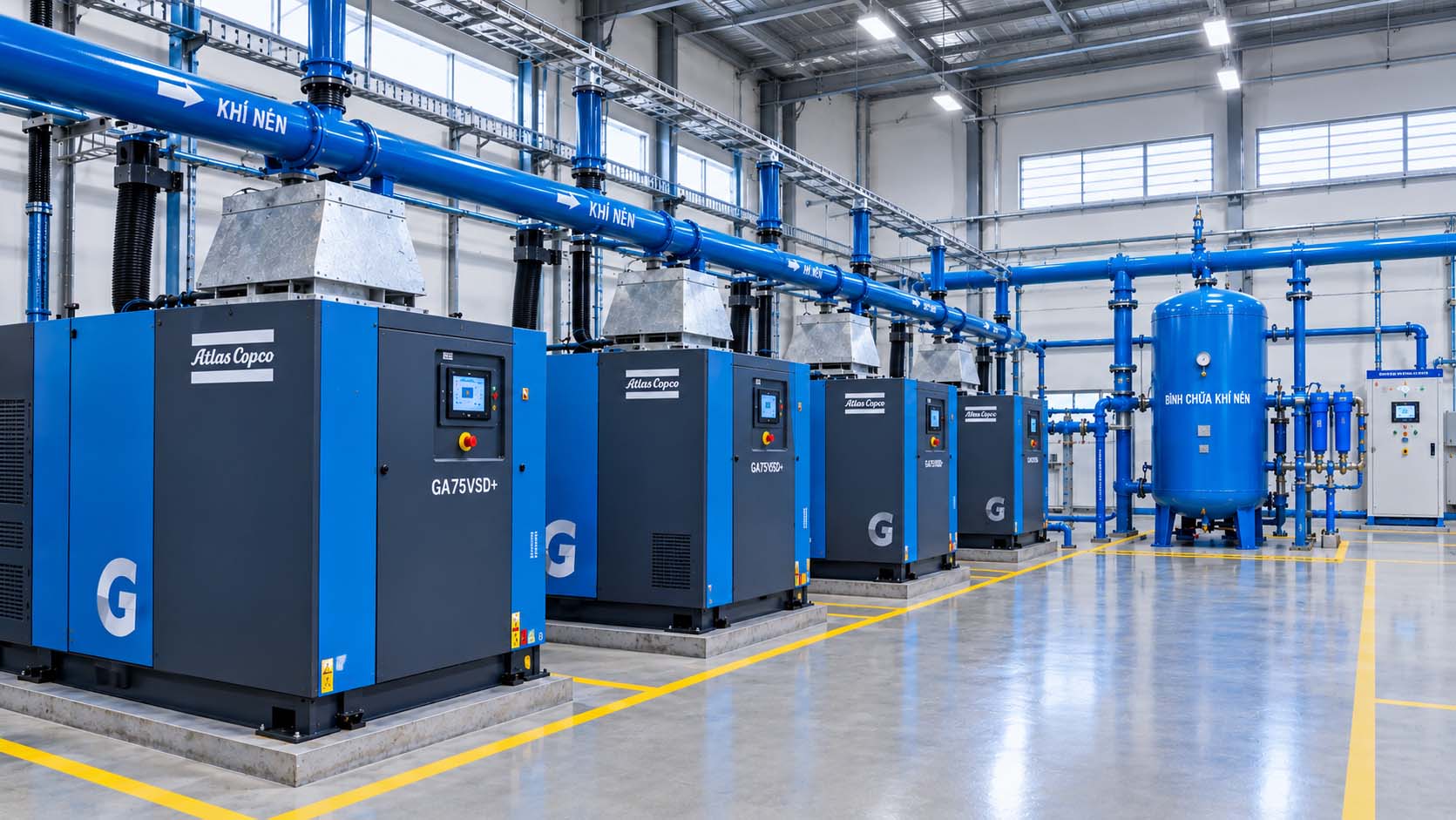
The five solutions at a glance
| Solution | Typical energy saving | Investment level |
|---|---|---|
| 1. Right-sized VSD compressor | Up to 35% for that machine | High |
| 2. Leak repair | 10–30% | Low |
| 3. Room ventilation and piping | 2–10% | Medium |
| 4. On-time filter changes and service | 3–5% | Low |
| 5. Central multi-compressor control | 10–20% | Medium |
The sensible sequence is to fix leaks and maintenance first, because they cost little and pay back fast. Then measure actual air demand before deciding on a VSD compressor or a central controller.
Frequently asked questions
How much energy does a VSD air compressor save? Up to 35% compared with a fixed speed unit when demand fluctuates. If load is steady near 100%, the saving is small.
How can I tell how much my system is leaking? Run the compressor with no equipment using air, time the loaded and unloaded periods, and apply T / (T + t).
Does lowering compressor pressure save energy? Yes. Each 1 bar reduction saves about 7% of energy, provided end-use equipment still gets enough pressure.
Get a free compressed air energy audit from Tay Ho Star
You can’t cut what you haven’t measured. Experienced engineers from Tay Ho Star will assess your plant’s compressed air energy performance free of charge: measuring actual flow and power, detecting leaks, inspecting the compressor room and piping, then proposing a savings roadmap with a clear payback period.
👉 Book your free audit today:
-
Hotline: 096 828 1912
-
Email: quanghuy@tayhostar.vn
-
Office Address: 91 Trung Kinh, Trung Hoa Ward, Cau Giay District, Hanoi, Vietnam
-
Website: https://tayhostar.vn/